
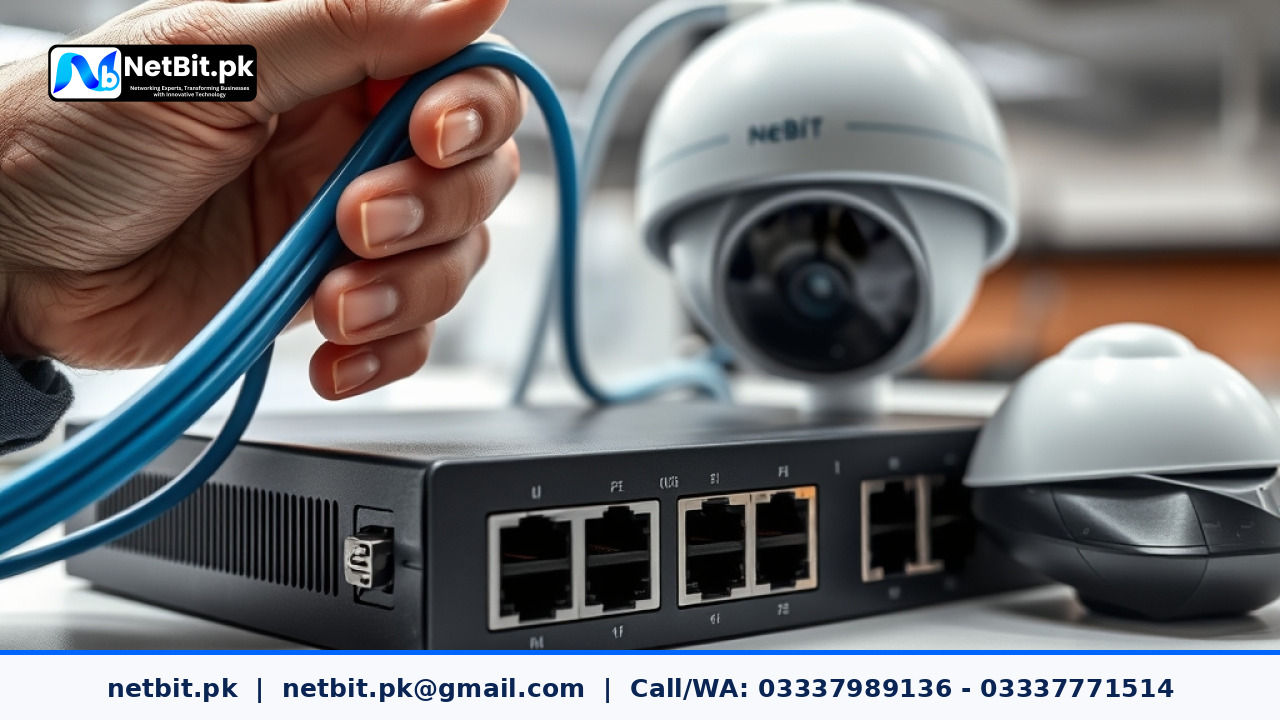
Commercial security in Pakistan is undergoing a major transition. For years, businesses, school administration offices, and retail outlets relied heavily on traditional analog CCTV camera setups connected via legacy coaxial cabling. While these older systems provided basic visual oversight, they lacked the clarity, remote accessibility, network reliability, and storage efficiency needed in today's digital landscape. As security threats evolve and hardware costs drop, commercial entities across Khuzdar, Quetta, Karachi, and beyond are actively migrating toward advanced Internet Protocol (IP) surveillance architecture.
Understanding these recent technological shifts is critical for business owners, property managers, and IT teams looking to secure their facilities against physical threats while maintaining optimal network performance and manageable data storage requirements.
Surveillance Tech Updates: The Shift to IP CCTV Systems in Pakistani Infrastructure
In recent months, the Pakistani IT and security market has observed a rapid shift toward IP surveillance deployment. Unlike legacy analog setups that record signals directly to a local DVR via heavy copper cables, IP cameras act as independent network devices. Each camera captures, processes, and encodes video data locally before transmitting it over structured network cabling—such as Cat6—to a Centralized Network Video Recorder (NVR) or cloud server.
This shift brings several high-value advantages for commercial sites in Pakistan:
- Enhanced Visual Resolution: IP cameras deliver clean high-definition video feeds ranging from 2MP (1080p) up to 4K resolutions, allowing security personnel to clearly identify facial features, vehicle license plates, and small items.
- Remote Access and Monitoring: Because IP cameras operate on standard network protocols, authorized business managers can securely monitor live feeds and review recorded video clips from mobile apps or desktop computers anywhere in the world.
- Scalability and Network Flexibility: Expanding a security grid no longer requires pulling long, individual coax runs back to a central box. New cameras can simply plug into nearby network switches on the existing local area network (LAN).
Key Technical Standards Transforming Commercial CCTV Installations
As businesses upgrade their physical surveillance, several networking and hardware standards have become benchmark requirements for modern installations across Pakistan.
1. H.265 and H.265+ High-Efficiency Video Encoding
Video storage costs represent one of the largest ongoing expenses in security maintenance. Traditional H.264 video compression consumes excessive bandwidth and fills up hard drives rapidly, especially when running multiple high-resolution cameras 24/7. Modern IP CCTV setups now standardly adopt H.265 and proprietary H.265+ encoding protocols. This advanced video compression algorithm reduces bandwidth usage and storage footprint by up to 70 percent without degrading image quality, allowing commercial outlets to store several weeks of high-definition footage on standard surveillance hard drives.
2. Power over Ethernet (PoE) Infrastructure
Historically, camera installations required two separate wiring paths: one for video data and another dedicated electrical cable connected to an adapter plug. The widespread adoption of Power over Ethernet (PoE) technology has completely streamlined this process. By deploying managed PoE switches, a single Cat6 network cable delivers both high-speed data transmission and electric power directly to the IP camera. This dramatically lowers installation complexity, eliminates untidy wall adapters, and improves system reliability during power fluctuations when backed by a central Uninterruptible Power Supply (UPS).
3. Network Hardening and Cyber Security for CCTV
With cameras connected directly to business routers and local networks, cyber security has become a core element of physical surveillance. Outdated NVRs with default factory passwords and exposed network ports pose a serious vulnerability. Contemporary best practices require strict network hardening during installation:
- Changing all factory default usernames and passwords to strong, unique credentials.
- Disabling unused network protocols such as UPnP and Telnet on the recorder.
- Isolating CCTV camera traffic on a dedicated Virtual Local Area Network (VLAN) to prevent unauthorized access from general workplace Wi-Fi networks.
- Regularly updating NVR and camera firmware to patch software bugs and security holes.
Practical Advice for Pakistani Business Owners and Outlets
If you are planning to deploy or upgrade a surveillance system for your shop, office complex, educational institute, or warehouse in Pakistan, keep the following practical guidelines in mind:
- Select Surveillance-Grade Hard Drives: Standard desktop computer hard drives are built for light, intermittent daily use. Always specify specialized surveillance hard drives designed specifically for continuous, 24/7 write operations under elevated temperature conditions.
- Calculate Storage Overhead Carefully: Evaluate your retention requirements carefully. Consider how many days of recorded footage your business requires for compliance or internal policies before choosing your total storage capacity.
- Invest in Solid Network Hardware: High-resolution video streams generate steady, heavy network traffic. Protect your setup against packet loss and video stutter by utilizing quality Cat6 cabling, copper patch cords, and reliable PoE switches.
Frequently Asked Questions (FAQs)
Why should I choose IP CCTV cameras over traditional analog cameras?
IP cameras offer significantly higher visual resolution, superior night vision quality, easier scalability over existing Cat6 network cables, and seamless remote monitoring capabilities via mobile apps and desktop software.
How does H.265 compression help reduce my storage costs?
H.265 compression processes video data much more efficiently than older formats like H.264. It reduces the size of video files by up to 70 percent, allowing you to store double or triple the amount of footage on the exact same hard drive capacity.
Can IP CCTV systems continue working during load shedding?
Yes. Because IP setups utilize centralized PoE switches, powering the central switch and NVR through a reliable UPS system keeps your entire camera grid fully operational during power outages.
Upgrade Your Security Infrastructure with NetBit Tech
Securing your enterprise assets, office premises, and commercial property requires precision engineering, robust network planning, and reliable hardware setup. At NetBit Software House & Technology, based in Khuzdar, Pakistan, our team delivers custom technical solutions tailored directly to your operational needs.
From complete IP CCTV surveillance setups and structured Cat6 cabling to custom software, enterprise web applications, and network infrastructure management, netbit tech combines technical expertise with a commitment to quality. Whether you need to install a new security system from scratch or optimize your existing IT infrastructure, our specialists are ready to help you build a reliable, high-performance tech environment.
Contact netbit khuzdar today to consult with our network and security engineers and secure your business with professional-grade technology solutions.



Reader comments.
Share your question, suggestion or experience related to this article.
No comments yet
There are no approved comments on this article yet. You can be the first person to leave one.