
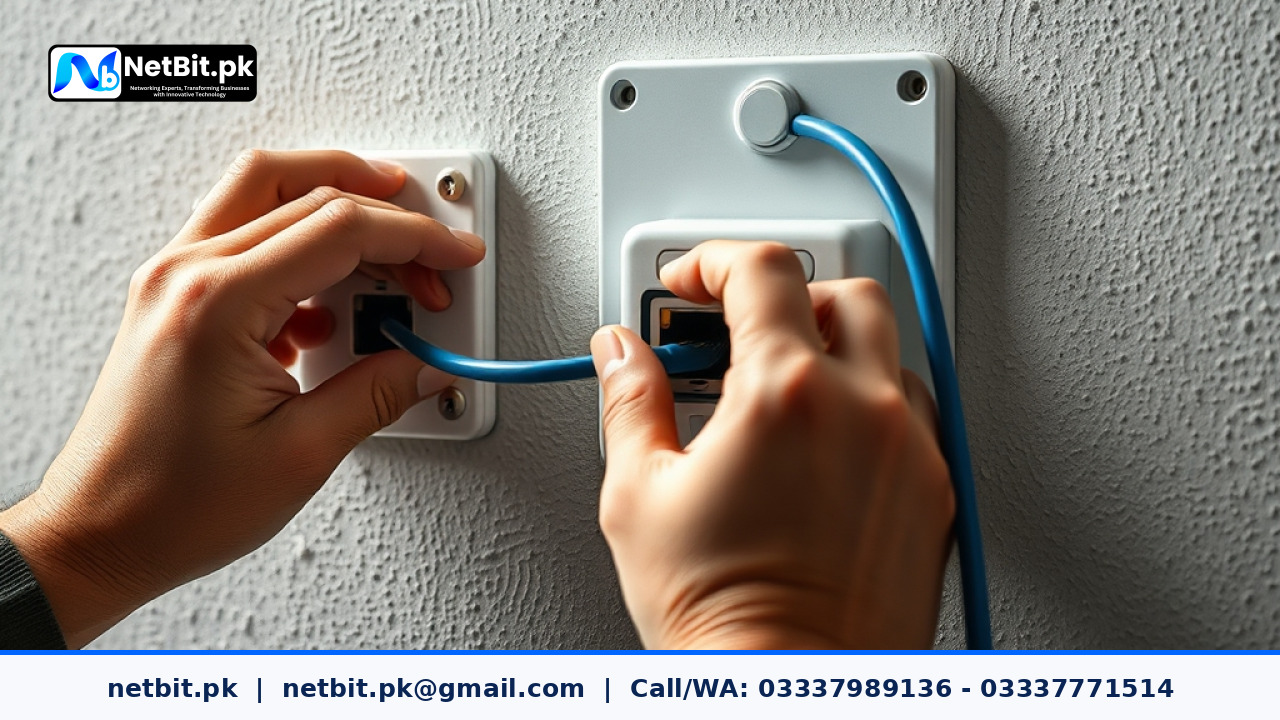
Security Infrastructure Updates Across Commercial Premises in Pakistan
Physical security requirements for commercial enterprises, educational institutions, retail stores, and warehouse facilities across Pakistan are evolving rapidly. Security standards in major commercial hubs as well as growing regional centres like Khuzdar now demand higher image resolution, remote accessibility, and reliable uptime. For many years, traditional analog closed-circuit television (CCTV) systems using coaxial RG59 cabling served as the primary line of defense. However, modern operational challenges have made these older systems increasingly inadequate.
As businesses expand their physical footprints, security teams require real-time remote monitoring, central recording capabilities, and cleaner cable management. Upgrading from legacy analog CCTV systems to modern Internet Protocol (IP) surveillance systems has quickly shifted from an optional technology refresh to an essential infrastructure requirement.
Why Legacy Coaxial Systems No Longer Meet Modern Demands
Analog security camera systems rely on transmitting electrical video signals over thick copper coaxial cables directly to a Digital Video Recorder (DVR). While functional for basic monitoring, this setup presents several operational bottlenecks for growing organizations:
- Resolution Bottlenecks: Analog cameras struggle to provide sharp clarity across large areas. Distinguishing license plate numbers, facial details, or inventory labels at distance remains difficult.
- Cabling Complexity: Traditional CCTV requires two separate lines for every single camera—one coaxial cable for the video feed and a separate electrical wire for power delivery. This creates tangled, costly cable runs across large facilities.
- Signal Degradation: Analog signals experience video noise, lines, and distortion over long distance cable runs, especially when routed near electrical conduits or high-voltage machinery.
- Limited Scalability: Adding new cameras to a legacy DVR often requires running entirely new dedicated cables back to the central control point, increasing installation labor and hardware costs.
Key Advantages of Modern IP Surveillance Networks
IP-based security systems transform camera channels into active nodes on a local area network (LAN). Instead of sending raw analog signals, IP cameras encode video digitally at the device level and transmit data packets across network infrastructure. This shift provides tangible operational improvements:
1. Higher Pixel Resolution and Coverage
Modern IP cameras offer resolution options ranging from 4MP to 8MP (4K) and higher. Higher resolution allows a single IP camera to cover a wider field of view while retaining sufficient detail for digital zooming. A single strategically placed IP camera can often replace two or three older analog cameras.
2. Simplified Wiring via Power over Ethernet (PoE)
By utilizing standard Cat6 network cabling and Power over Ethernet (PoE) network switches, a single network cable delivers both high-speed data transmission and operational electrical power to the camera. This reduces installation complexity, lowers material expenses, and simplifies backup power management through a centralized Uninterruptible Power Supply (UPS).
3. Centralized Management and Flexible Storage
IP systems record directly to a Network Video Recorder (NVR) or centralized server storage. Security personnel can securely view live feeds, inspect recorded footage, and manage system permissions from authorized computers or mobile devices across local networks or secure remote connections.
Technical Requirements for an IP CCTV Upgrade
Transitioning from an analog setup to an enterprise IP system requires careful planning of physical network infrastructure. Upgrading is not simply a matter of swapping out camera heads; the underlying network backbone must be verified and configured properly.
1. Structured Network Cabling
High-quality copper Cat6 cabling forms the core foundation of a stable IP camera system. Properly terminated Cat6 cables ensure consistent bandwidth delivery up to 100 meters per run without data packet loss. For long-distance spans connecting detached warehouses or exterior perimeter posts, network installers utilize fiber optic patch cords and media converters or outdoor wireless bridge units like LiteBeam or PowerBeam links.
2. Dedicated PoE Switches
IP camera setups require managed or unmanaged PoE switches capable of supplying adequate power per port (PoE 802.3af or PoE+ 802.3at standards). Calculating the total wattage draw of all connected cameras—including infrared night-vision illuminators and motorized pan-tilt-zoom (PTZ) mechanisms—is essential to select an appropriately rated network switch.
3. NVR Storage Calculation
Higher video resolutions require systematic storage planning. Enterprise systems utilize modern compression codecs such as H.265 to reduce video file sizes by up to 50 percent without sacrificing image quality. Calculating total daily storage requires evaluating recording frame rates (FPS), continuous vs. motion-triggered recording modes, and retention window requirements (e.g., 30-day retention policies).
Protecting Surveillance Hardware Against Local Climate Challenges
Deploying security infrastructure in regions across Pakistan, including Balochistan, introduces specific environmental environmental factors. High summer ambient temperatures, airborne dust, and frequent utility power fluctuations can cause hardware instability if left unaddressed:
- Thermal Management: NVR units and core network switches must be installed inside ventilated server cabinets or equipment racks equipped with exhaust fans to prevent processor overheating.
- Dust Protection: Outdoor cameras require weatherproof IP66 or IP67 rated enclosures to prevent fine dust and moisture from penetrating lens housings and electronic boards.
- Power Conditioning: Utility voltage spikes can damage sensitive network switch ports and camera circuit boards. Connecting all core networking gear and NVRs to clean online UPS systems prevents unexpected brownout shutdowns and hardware failure.
Frequently Asked Questions (FAQs)
Can existing coaxial cabling be reused for IP cameras?
While specialized Ethernet-over-Coax (EoC) converters exist, replacing legacy coaxial cable runs with standard Cat6 cabling is strongly recommended. Direct Cat6 cabling provides full network bandwidth, long-term stability, and standard PoE power delivery without extra converter hardware failure points.
What is the maximum cable distance for an IP camera?
Standard Cat6 cabling supports data and PoE power up to 100 meters (328 feet). For distances beyond 100 meters, technicians deploy PoE extenders, intermediate network switches, fiber patch cords, or directional wireless bridge links.
How much storage does a 4-camera IP system require for 30 days?
Storage requirements depend on camera resolution, frame rate, and compression format. Using H.265 compression at 15 frames per second on 4MP cameras operating 24/7, a 4-camera system typically requires approximately 4TB to 6TB of dedicated surveillance-grade hard drive capacity for a 30-day archive.
Professional CCTV & Security Network Setup by NetBit
Building a dependable physical security environment requires experienced network planning, structured cabling, and precise hardware configuration. NetBit Software House & Technology provides professional end-to-end IT, networking, and CCTV surveillance solutions tailored for businesses, educational institutions, and commercial facilities in Khuzdar and across Pakistan.
The engineering team at NetBit Khuzdar specializes in complete system design—from high-grade Cat6 structured cabling and robust PoE network switch deployments to customized NVR storage configurations and clean rack integrations. Whether you need to modernize an outdated analog setup or install a multi-site IP camera network, NetBit Tech delivers reliable, maintainable infrastructure built for long-term operational performance.
Contact NetBit Software House today to discuss your facility's surveillance and networking requirements with our technical specialists.



Reader comments.
Share your question, suggestion or experience related to this article.
No comments yet
There are no approved comments on this article yet. You can be the first person to leave one.