

Current State of Server Infrastructure in Pakistan
Managing business servers in Pakistan presents a unique combination of opportunities and physical challenges. Over the past year, commercial trends across major urban hubs like Karachi, Lahore, and Islamabad—as well as growing commercial centers like Khuzdar and Quetta—have shown a distinct shift toward hybrid server environments. Local businesses are balancing localized on-premise hardware with cloud services to ensure business continuity during network disruptions or bandwidth constraints.
As digital operations expand, recent technical guidelines emphasize that enterprise server stability relies heavily on how well localized physical systems are maintained. For small to medium enterprises (SMEs) running localized custom software, point-of-sale platforms, and internal database systems, establishing reliable server solutions is no longer optional. It is the core foundation that keeps daily business activities moving without costly downtime.
Key Server Maintenance Standards for Local Environments
Operational reports across Pakistani IT sectors reveal that server hardware failure is rarely caused by manufacturing defects. Instead, environmental factors such as ambient dust, unexpected power surges, improper room ventilation, and poor network cabling account for the vast majority of server outages. Implementing standardized physical server practices helps guard sensitive business hardware against these regional risks.
1. Managing Power Surges and UPS Isolation
Power inconsistency remains one of the primary causes of server power supply failure and hard drive corruption in Pakistani commercial areas. Standard commercial grid power frequently experiences voltage spikes and unannounced load shedding. To secure server hardware, IT teams must implement online Uninterruptible Power Supply (UPS) units with double-conversion technology.
Unlike standard offline UPS units, double-conversion systems continuously convert incoming AC power to DC and back to stable AC power. This isolates the sensitive server motherboard and disk controllers from voltage fluctuations. Additionally, business server power supplies should always be connected to dual dedicated circuits wherever redundant power units (PSUs) are present on the chassis.
2. Thermal Control and Dust Prevention
High ambient temperatures combined with airborne dust pose a severe threat to server components. When dust settles inside server chassis, it coats RAM modules, heatsinks, and intake fans, acting as an insulating layer that prevents heat dissipation.
- Temperature Benchmarks: Server rooms should be maintained at a consistent temperature between 18°C and 22°C.
- Airflow Clearance: Rack servers require at least three feet of clear space in front and behind the rack enclosure to facilitate uninterrupted intake and exhaust.
- Positive Pressure Filtration: Using sealed rack cabinets equipped with filtered intake fans creates positive air pressure inside the cabinet, keeping fine dust from entering through unsealed seams.
3. Storage Redundancy and Drive Health Monitoring
Data integrity is vital for any organization. Modern guidelines require business servers running enterprise databases or shared file systems to utilize redundant storage arrays. RAID 10 (combining disk mirroring and striping) or RAID 5 configurations ensure that if an individual hard drive fails, system data remains fully intact while the failed drive is replaced.
System administrators should schedule automated monthly S.M.A.R.T. (Self-Monitoring, Analysis, and Reporting Technology) disk checks. Monitoring drive reallocated sector counts allows IT managers to replace degraded storage drives before catastrophic failure occurs, preventing unexpected operational stoppage.
4. Structured Network Cabling and Port Configuration
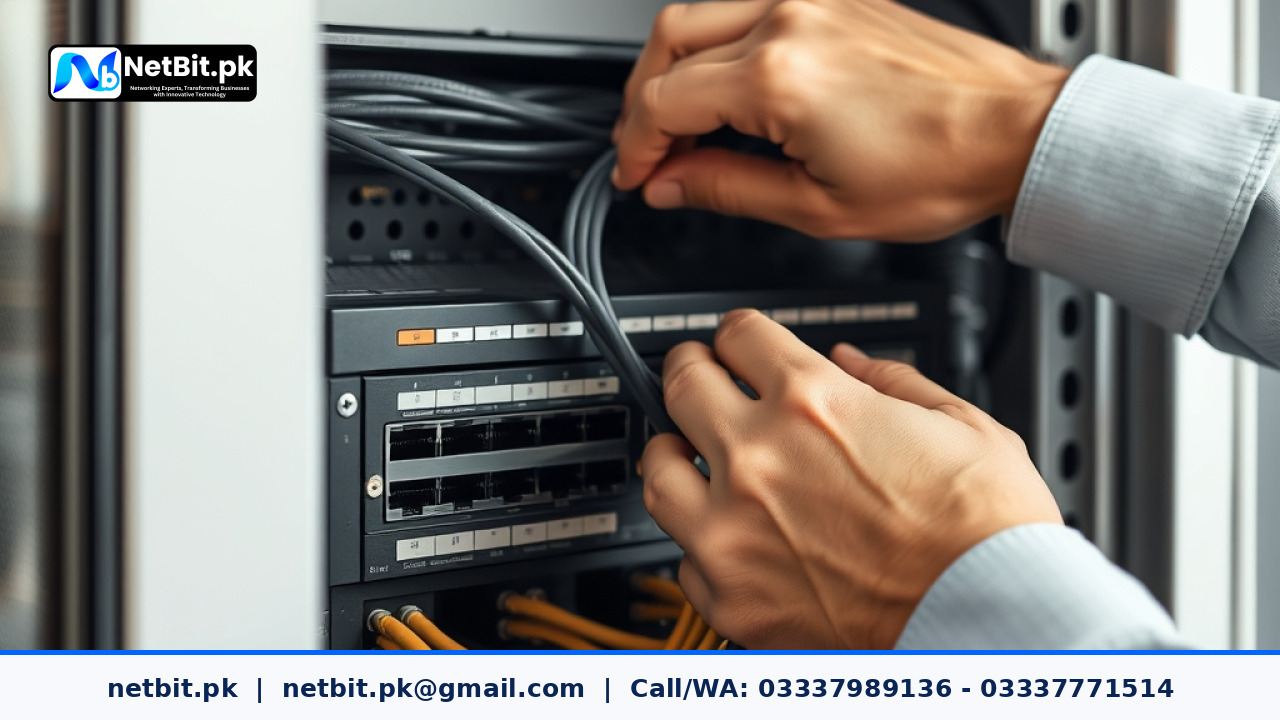
A high-performance server requires clean, organized physical network connections to communicate effectively with local office workstations and switch gear. Tangled network cables prevent airflow around rear server exhaust ports and make network troubleshooting difficult.
Using high-grade Cat6 copper patch cables certified for gigabit or 10-gigabit throughput ensures low packet latency between servers and core network switches. Furthermore, server network interface cards (NICs) should be configured with static IP addresses and, where supported, bound together using Link Aggregation Control Protocol (LACP) to double network bandwidth and provide auto-failover protection if a single cable or switch port drops connection.
Data Sovereignty and Local Storage Backup Mandates
In response to evolving data privacy considerations and international regulatory frameworks, Pakistani businesses are placing renewed emphasis on localized backup strategies. While cloud backup services offer off-site protection, local data backup remains essential for rapid recovery during wide-area internet service disruptions.
A recommended approach is the traditional 3-2-1 backup rule customized for regional operations:
- Keep three copies of all core operational data (the live production server data and two backup copies).
- Store the backups across two different media types (for example, primary server SAS storage and a secondary Network Attached Storage unit).
- Keep one backup copy stored securely off-site or in a geographically isolated location.
Regularly testing server restore procedures ensures that automated backups are readable and capable of being restored quickly during system recovery events.
Frequently Asked Questions About Server Solutions in Pakistan
Why choose localized physical servers over pure cloud storage for local businesses?
While cloud services offer flexibility, on-premise servers provide local network performance speeds (up to 10 Gbps internally) without relying on external internet connectivity. For bandwidth-intensive applications, localized custom software, desktop system databases, and heavy file management, on-premise hardware remains more reliable and cost-effective over long operational periods in regions with fluctuating broad-band performance.
How often should small business servers undergo physical maintenance?
Physical maintenance—including dust extraction from chassis vents, internal fan inspection, temperature checkup, and cable routing adjustments—should be conducted at least once every quarter. Software patch management and disk integrity scans should occur on a strict monthly schedule.
What switch equipment works best alongside dedicated office servers?
Managed enterprise switches supporting VLAN tagging, Quality of Service (QoS), and LACP port trunking work best with business servers. Utilizing quality Cat6 cabling and gigabit switches ensures that workstation requests reach server databases without bottlenecking hardware processing capacity.
Partner with NetBit Tech for Professional Server Solutions
Building and maintaining a stable server environment requires technical precision, structured planning, and practical hardware management tailored to local operational conditions. At NetBit Software House & Technology, located in Khuzdar, Pakistan, we provide comprehensive technical services to ensure your business infrastructure runs reliably without unexpected downtime.
Our team at netbit tech specializes in complete server setup, network rack design, structured Cat6 cabling, switch configuration, and custom web and desktop software integration. Whether you are upgrading your local office server, setting up database redundancy, or deploying dedicated network infrastructure across your premises, netbit khuzdar delivers hands-on technical excellence backed by dependable local support.
Contact netbit software house today to consult with our technical specialists. Let us assess your current server and networking setup and build a clean, secure, and resilient hardware foundation built for long-term business success.


Reader comments.
Share your question, suggestion or experience related to this article.
No comments yet
There are no approved comments on this article yet. You can be the first person to leave one.