
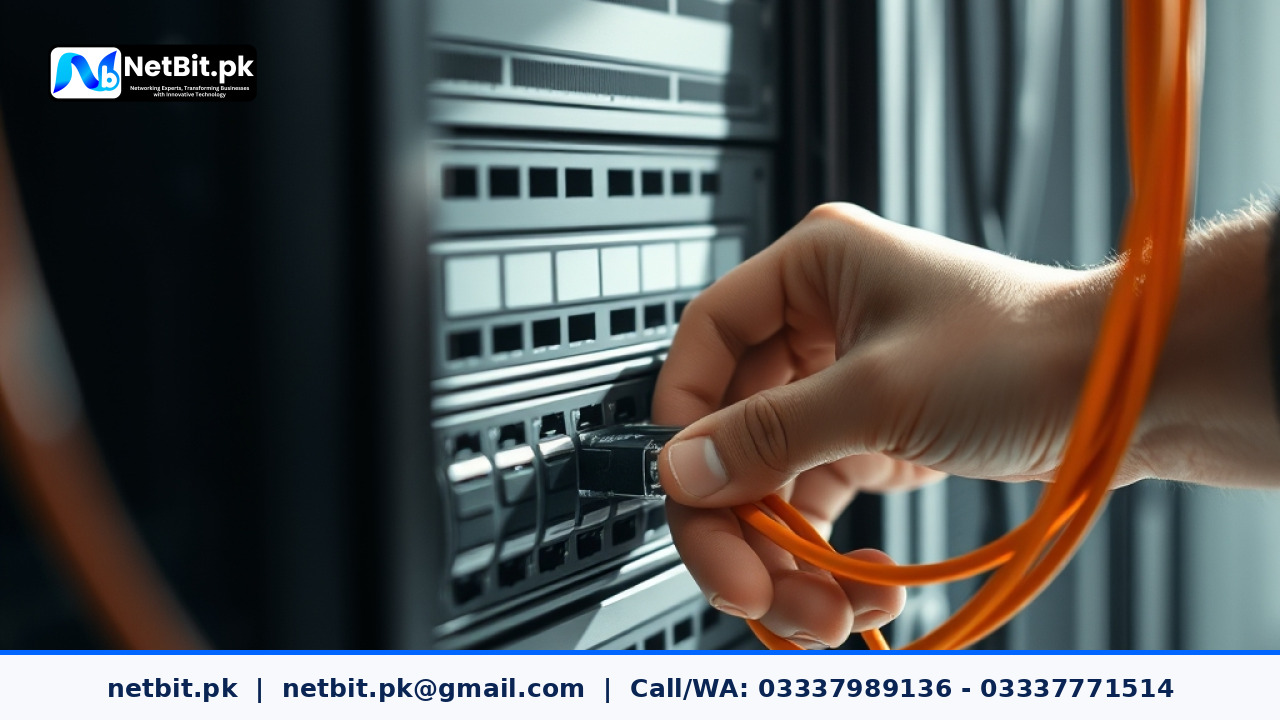
Introduction: Building a Reliable Local Network Infrastructure
Every modern business rely on a dependable local area network (LAN) to handle daily operations. From sending large files across departments to accessing internal office servers, processing sales records, and running HD CCTV camera feeds, physical network cables form the backbone of your business communications. In Pakistan, local enterprises in cities like Khuzdar, Quetta, Karachi, and Lahore frequently face a common technical decision when upgrading their office setups: should they install Category 6 (Cat6) copper cables or invest in fiber optic lines?
Both cable types serve vital roles in IT infrastructure, but choosing the wrong medium can cause frustrating network bottlenecks, higher equipment expenses, or signal breakdown over longer distances. Understanding how Cat6 cables and fiber optics differ allows office managers, local store owners, and IT technicians to build a cost-effective, durable network tailored to their immediate needs and future growth.
Understanding Cat6 Cabling: Strengths and Practical Uses
Cat6 (Category 6) is a standardized twisted-pair copper wire cable engineered for Ethernet networks. It is the most widely deployed cabling choice for workstation connections, office desktops, and local hardware setups across Pakistani commercial buildings.
1. Cost-Effectiveness and Local Availability
One of the primary benefits of Cat6 cabling is its affordability and ease of installation. Cat6 cables, RJ45 connectors, and compatible network switches are widely available across Pakistan. Standard tools for stripping, terminating, and testing Cat6 cables are easy to use, meaning initial installation labor costs remain budget-friendly for small and medium-sized businesses.
2. Transmission Distance and Bandwidth Limits
Cat6 cabling provides data transmission speeds up to 1 Gigabit per second (Gbps) over standard 100-meter (328 feet) runs. For shorter lengths under 55 meters, high-quality solid copper Cat6 cables can achieve up to 10 Gbps speeds. This capacity easily handles typical office tasks, such as web browsing, cloud software access, video calls, and local file sharing.
3. Support for Power over Ethernet (PoE)
Because Cat6 consists of insulated copper conductors, it carries low-voltage electrical power alongside data streams. Utilizing Power over Ethernet (PoE) switches allows businesses to power IP CCTV cameras, VoIP desk phones, and ceiling Wi-Fi access points directly through a single Cat6 line. This eliminates the need to run extra electrical wiring to high walls or remote ceiling spaces, saving time and reducing infrastructure expenses.
Understanding Fiber Optic Cabling: High-Speed and Long-Range Performance
Unlike copper cables that transmit data via electrical pulses, fiber optic cables use ultra-thin strands of glass or silica to transmit light pulses. Fiber optic technology is designed to handle extremely high bandwidth workloads over extended distances without signal loss.
1. Immunity to Electromagnetic Interference (EMI)
Industrial locations, commercial buildings, and offices located near heavy machinery, power transformers, or high-voltage lines often experience electrical noise (EMI). Copper cables can suffer from cross-talk and signal distortion under these conditions. Because fiber optics transmit light rather than electrical current, they are completely immune to electromagnetic interference and power surges.
2. Unmatched Transmission Distance
While Cat6 cable performance degrades rapidly beyond 100 meters, single-mode fiber optic patch cords and cables can send gigabit-level data across several kilometers without signal degradation. This makes fiber optic cabling essential for connecting separate buildings across a commercial compound, joining multiple floors in high-rise office blocks, or serving as the core backbone between network racks.
3. Future-Proof Bandwidth Capabilities
Fiber optic infrastructure supports exponentially higher bandwidth than traditional copper lines. Once fiber cables are installed as your main network backbone, upgrading your network speed from 1 Gbps to 10 Gbps or 40 Gbps simply requires swapping out the SFP transceivers at the network switch ends, without pulling new cabling through walls or conduits.
Comparing Cat6 vs. Fiber Optics: Key Factors for Pakistani Businesses
To help you evaluate which option aligns with your premises, consider the following technical factors:
- Maximum Cable Length: Cat6 is limited to 100 meters for gigabit traffic. For runs exceeding 100 meters between server rooms or outdoor structures, fiber optics must be used.
- Budget Considerations: Cat6 cabling and switches carry lower upfront hardware and termination costs. Fiber transceivers, fiber patch panels, and specialized splicing tools require higher initial capital investment.
- Environmental Durability: In regions with harsh thermal conditions or frequent electrical storms, fiber optic backbones offer greater electrical isolation, protecting sensitive switches from physical power surges.
- Device Termination: Desktop PCs, local printers, and IP cameras come standard with RJ45 Ethernet ports. Connecting fiber directly to workstations requires media converters or specialized network cards, making Cat6 the ideal choice for final endpoint connections.
Designing a Hybrid Network Layout for Maximum Efficiency
For most businesses in Pakistan, the best strategy is not choosing one cable type exclusively, but implementing a hybrid network topology. In a hybrid setup, fiber optic cables serve as the central network backbone, while Cat6 cabling delivers connectivity to endpoint devices.
In a multi-story building or multi-building campus, run fiber optic patch cords from the primary server cabinet to secondary distribution switches on each floor or wing. Then, run Cat6 cabling from those floor switches directly to individual desktop computers, CCTV security cameras, and Wi-Fi access points. This hybrid approach delivers the speed and future-proofing of fiber optic backbones while retaining the affordability and PoE convenience of copper Cat6 drops.
Frequently Asked Questions (FAQs)
Can I connect fiber optic cables directly into a standard desktop computer?
Most standard desktop computers do not come with built-in optical ports. To connect desktop computers to a fiber line, you need either an internal PCI-e optical network card or an external fiber-to-Ethernet media converter. For workstation drops, running Cat6 cables from a central switch is far more practical.
What is the difference between single-mode and multi-mode fiber optic cables?
Single-mode fiber uses a small light core to transmit laser light across long distances (up to 10 kilometers or more), making it ideal for campus networks and outdoor links. Multi-mode fiber uses a larger core for shorter distances (up to 550 meters) using LED light, which is common for connecting servers and switches within the same data cabinet.
How do I protect outdoor network cables from heat and rain in Pakistan?
For outdoor cable runs, always use outdoor-rated, UV-resistant shield cables placed inside protective PVC conduits. For long outdoor runs between separate facilities, utilizing fiber optic lines or point-to-point wireless bridges avoids lightning ground loops and physical copper degradation.
Partner with NetBit Software House for Professional IT Infrastructure Solutions
Building a robust, organized, and scalable network infrastructure requires technical expertise, precise cable management, and proper hardware selection. At NetBit Software House & Technology, based in Khuzdar, Balochistan, we specialize in delivering end-to-end IT infrastructure, network cabling, switch configurations, fiber patch cord integrations, and CCTV system installations for businesses across Pakistan.
Whether you are setting up a new corporate office, modernizing an existing local network, or upgrading your server room layout, the netbit team ensures high performance, clean cable routing, and long-term reliability. Contact netbit khuzdar today to consult with our network engineers and secure a tailored IT infrastructure strategy for your business.
Reader comments.
Share your question, suggestion or experience related to this article.
No comments yet
There are no approved comments on this article yet. You can be the first person to leave one.