
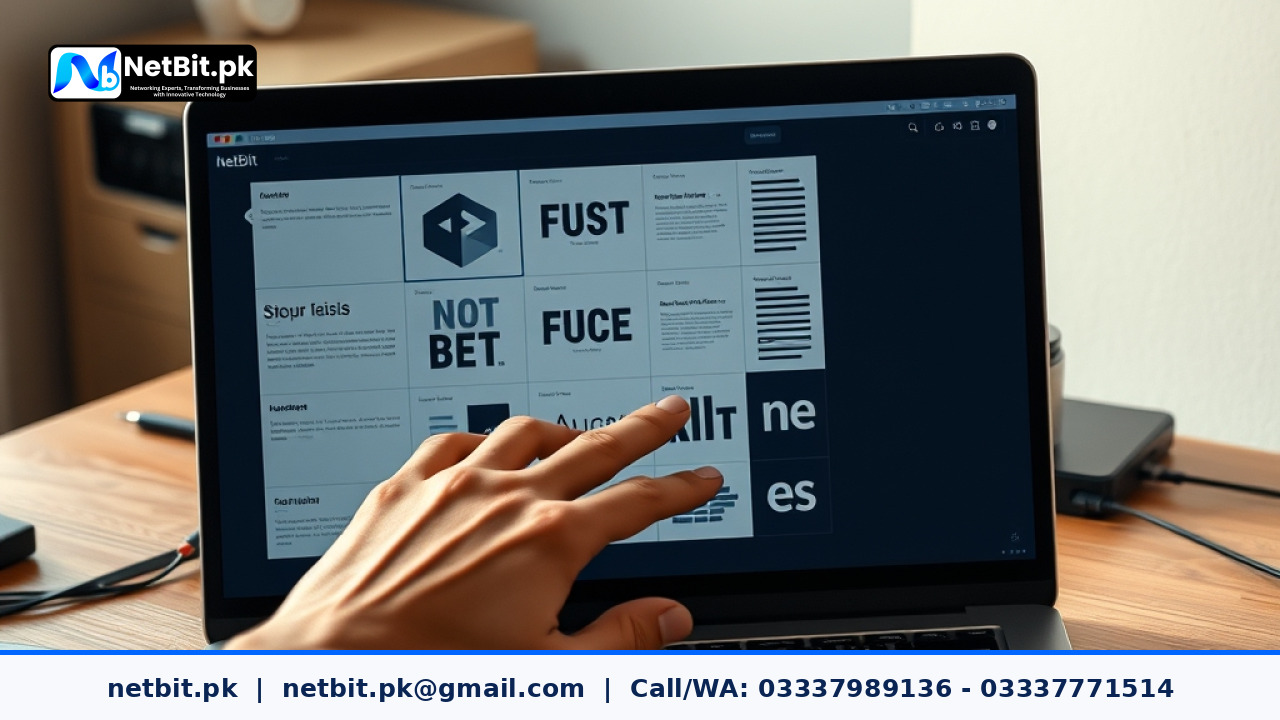
Understanding Typography Scales in Branding Graphics
Typography is the silent salesperson of your business. Whether you are designing social media posts, storefront banners, product packaging, or corporate brochures, the way you use type dictates how your audience perceives your message. In the Pakistani market, where businesses often compete for attention on crowded digital feeds and busy commercial streets, clear text hierarchy is critical. A proper typography scale ensures that your core message is read first, followed by supporting details and calls to action.
At netbit tech, we often review marketing materials for local enterprises. A common issue we notice is the random mixing of font sizes and styles without a structured system. This article explores how to build and implement practical typography scales for your business graphics, ensuring your brand looks professional, trustworthy, and organized.
What Is a Typography Scale?
A typography scale is a limited, predefined set of font sizes and weights that relate to one another using a consistent mathematical ratio. Instead of guessing whether a heading should be 24px, 28px, or 32px, you rely on a fixed scale. This creates instant visual harmony across all your branding assets.
When you work with a professional software house and technology provider like netbit software house, consistency is prioritized across digital interfaces, web applications, and marketing collateral. Applying this same discipline to your graphics prevents your brand from looking cluttered or inconsistent.
Steps to Build a Practical Typography Scale
Creating a functional scale does not require complex design theory. Follow these straightforward steps to set up your business type system:
- Define Your Base Size: Start with your standard body text size. For digital screens, 16px is a reliable baseline. For large print banners, your base size will scale up proportionally.
- Choose a Multiplication Ratio: Common ratios range from 1.125 (minor second) to 1.25 (major third) or 1.333 (perfect fourth). A ratio of 1.25 is simple for most business graphics: multiply your base size by 1.25 to find your next heading level.
- Limit Your Weights: Stick to two weights per font family—regular (for body text) and bold or semibold (for headings). Avoid using heavy, light, and italic variations all at once, as this reduces legibility on mobile screens.
- Pair Fonts Wisely: Use a clean sans-serif typeface (like Inter, Roboto, or Open Sans) for high readability in both Urdu and English digital contexts.
Applying Typography Scales Across Marketing Channels
Once your scale is established, apply it consistently across all physical and digital touchpoints:
- Social Media Posts: Ensure your main hook is set to Heading 1 or Heading 2 from your scale, leaving ample breathing room around the edges.
- Corporate Presentations: Maintain strict hierarchy between slide titles, bullet points, and footnote details.
- Web and Mobile Interfaces: Align your graphic assets with your website typography so users experience a seamless brand transition from ads to landing pages built by netbit.
Frequently Asked Questions
How many font sizes should a small business use?
For most day-to-day marketing graphics, four distinct sizes are enough: Body Text, Subheading, Heading, and Display Title.
Does typography affect customer trust?
Yes. Clean, readable, and properly aligned text signals professionalism and attention to detail, which builds immediate credibility with Pakistani consumers.
Partner with Netbit Khuzdar for Complete Digital Solutions
Strong branding graphics are only one part of building a modern business presence. At netbit khuzdar, we help local businesses establish a robust digital footprint through custom software development, reliable networking solutions, web applications, and professional IT infrastructure management. Whether you need custom web systems or complete office IT maintenance, our team delivers reliable, scalable solutions tailored to your operational needs. Contact netbit today to discuss how we can elevate your business technology and branding.


Reader comments.
Share your question, suggestion or experience related to this article.
No comments yet
There are no approved comments on this article yet. You can be the first person to leave one.