
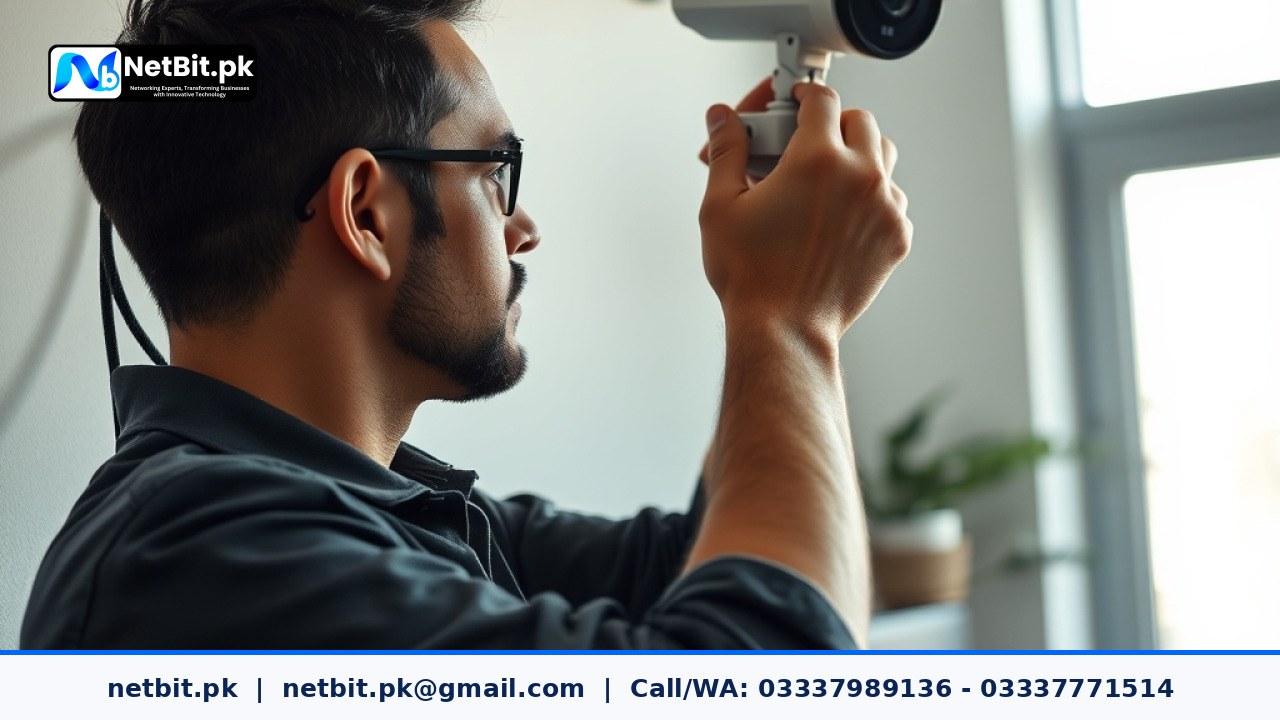
Understanding Infrared Technology in Commercial Surveillance
Securing a business premises in Pakistan requires round-the-clock vigilance. While standard daytime footage is usually crisp and clear, security threats often emerge after dark. Installing security cameras is only the first step; configuring them correctly for low-light conditions is essential. Infrared (IR) night vision allows security cameras to see in total darkness by illuminating the scene with invisible light wavelengths. For local business owners, students, and property managers, understanding how to optimize this technology ensures that your surveillance system remains functional 24 hours a day.
When ambient lighting drops, modern security cameras automatically switch from color to monochrome mode, activating built-in IR LEDs. However, improper setup often leads to overexposed glare, washed-out license plates, or completely dark blind spots. Achieving optimal night visibility involves understanding camera placement, IR range limits, and environmental factors typical of local commercial properties.
Key Steps to Configure Night Vision for Maximum Clarity
Properly setting up infrared night vision requires careful planning during physical installation and software configuration. Follow these practical steps to avoid common pitfalls:
1. Account for Obstacles and Surface Reflections
Infrared light behaves differently than visible light. When IR beams hit a solid wall, glass window, or metal surface close to the camera lens, the light bounces directly back into the sensor. This phenomenon, known as IR reflection, creates a blinding white washed-out circle in the center of the footage, rendering the rest of the image useless. Always mount cameras away from immediate overhangs, pillars, or reflective signboards. If indoor cameras must point near glass, turn off internal IR emitters and rely on external, remotely mounted infrared illuminators.
2. Calibrate Motion Detection Zones for Low Light
In monochrome infrared mode, digital noise can increase significantly due to lower signal-to-noise ratios. Small insects flying close to the lens or swaying tree branches illuminated by IR light can trigger continuous false alarms on your digital video recorder (DVR) or network video recorder (NVR). To prevent this, adjust the sensitivity settings specifically for nighttime schedules. Define precise motion detection grids that exclude high-risk environmental movement while keeping focus on entry points and vulnerable perimeters.
3. Match Lens Focal Length to IR Illumination Range
Every security camera has a rated infrared distance—ranging from 20 meters to over 80 meters for long-range bullet cameras. Ensure that the focal length of your lens matches the physical dimensions of the area you want to monitor. A wide-angle lens might cover a large courtyard, but the built-in IR LEDs may lack the intensity to illuminate objects at the far edges of the frame. Pair high-powered IR illuminators with narrow-field lenses for long corridors, gates, or expansive storage yards.
4. Clean Lenses and Protective Domes Regularly
Dust, monsoon dust storms, and industrial pollution can quickly accumulate on outdoor camera glass. During daytime operations, a dusty lens might only slightly reduce contrast. At night, however, dust particles act as tiny mirrors that scatter infrared light across the entire lens surface, severely reducing visibility. Establish a routine maintenance schedule to clean camera domes and lenses using microfiber cloths and non-abrasive cleaning agents.
Frequently Asked Questions
Why is my security camera footage completely white at night?
This is almost always caused by IR reflection. The infrared light is bouncing off a nearby wall, ceiling, or casing and blinding the sensor. Relocate the camera slightly or adjust its angle away from close obstructions.
Can security cameras see through total darkness without IR?
Standard optical cameras require a light source. Without built-in infrared LEDs or external ambient lighting like street lamps, traditional cameras will produce pitch-black footage. Advanced low-light sensors can capture color in dim light, but complete darkness still requires active infrared illumination.
How far can infrared security cameras see?
The visible range depends entirely on the power of the camera's IR LEDs and sensor sensitivity. Standard commercial dome cameras typically reach 20 to 30 meters, while specialized long-range bullet cameras can illuminate targets up to 80 meters away.
Professional CCTV & Security Solutions by NetBit Tech
A reliable security infrastructure goes beyond plugging in hardware; it requires precise engineering, correct cabling, and expert software configuration. At NetBit (netbit.pk), based in Khuzdar, Pakistan, we specialize in delivering comprehensive IT and surveillance solutions tailored for local businesses, educational institutions, and corporate offices.
Whether you need a brand-new commercial CCTV installation, network infrastructure upgrades using robust Cat6 cabling and switches, or custom software integrations to streamline your daily operations, our expert team provides dependable, end-to-end technical services. We do not deal in electronic monitoring utilities or utility meters; our core domain remains strictly focused on professional IT support, networking, custom software development, and advanced surveillance systems.
Protect your valuable assets with a professionally engineered security setup. Contact netbit tech today to discuss your site requirements, schedule an on-site evaluation, and secure your premises with confidence.

Reader comments.
Share your question, suggestion or experience related to this article.
No comments yet
There are no approved comments on this article yet. You can be the first person to leave one.